Rashi calculator: find your moon sign
Your rashi is the sign the Moon was in when you were born. Enter your name, birth date, birth time and birth place, and the calculator gives your rashi with its nakshatra, pada and lagna, and shows the hours each one held, so you can see whether a few minutes either way would change it.
What is a rashi?
A rashi is one of the twelve signs of the zodiac, each 30 degrees wide, counted from the fixed stars. Your rashi, or janma rashi, is the sign the Moon occupied at the moment of your birth. It is the sign your horoscope in the newspaper means when it says Mesha or Vrishabha, and the one a pandit reads first for a name, a kundali or a match.
It is not the sign most Western sites call your star sign. That one is the Sun’s sign, and it is counted from the equinox rather than the stars, so it runs about 24 degrees ahead. Someone born on 1 May is Taurus by the Western reckoning, Mesha by the sidereal Sun, and could be any of the twelve by the Moon. The calculator shows the sidereal Sun sign too, so the difference is in front of you.
Why does it need my birth time and place?
Because the Moon moves fast. It covers about 13 degrees a day, so it leaves one rashi for the next roughly every two and a quarter days. We counted every day from 1960 to 2025: on 43.9% of them the Moon changed rashi at some hour of the day. For nearly half of all birthdays, the date alone cannot tell you the rashi.
The place matters for two reasons. It fixes the time zone and the clock rules in force on that date, such as India’s war time of 1942 to 1945, when clocks ran an hour ahead, or summer time abroad. It also sets the horizon, and the lagna is the sign rising on that horizon. The lagna changes about every two hours, so it needs the birth time even more than the rashi does.
How is the rashi calculated?
The calculator converts your birth time to universal time using the time zone history of your birth place, then works out where the Moon stood against the stars at that instant. It subtracts the Lahiri ayanamsa, the standard the Indian Calendar Reform Committee fixed in 1956 and the one almost every Indian panchang uses. The Moon’s sidereal longitude divided by 30 degrees gives the rashi, by 13 degrees 20 minutes the nakshatra, and by 3 degrees 20 minutes the pada.
The same engine computes the panchang timings on this site. Its Moon and lagna positions were checked against Swiss Ephemeris, the standard astronomical library of astrology software, over 400 random births from 1930 to 2040: they agree within 9 arcseconds, while a pada is 12,000 arcseconds wide. Its ayanamsa matches a published reference panchang within 18 arcseconds. The methodology page explains how the engine is tested.
What if my birth time is not exact?
Look at the hours shown under each answer. If your birth time sits well inside them, a birth certificate rounded to the nearest quarter hour does not matter. If it sits within 30 minutes of either end, the calculator says so and names the answer on the other side. In that case, ask your family for the time written at the hospital, or for the sign the pandit gave at your naming ceremony.
Nakshatra and pada are more sensitive than rashi. A pada lasts about six hours, so a birth near its edge can change the pada, and with it the first syllable traditionally used for a name, even when the rashi is safe.
Which nakshatras fall in each rashi?
Each rashi holds exactly nine padas, which is two and a quarter nakshatras. The table below lists them with the planet that rules each rashi. If you already know your nakshatra and pada, it tells you your rashi without a calculation.
| Rashi | Western name | Lord | Nakshatra padas |
|---|---|---|---|
| Mesha | Aries | Mars (Mangal) | Ashwini 1–4, Bharani 1–4, Krittika 1 |
| Vrishabha | Taurus | Venus (Shukra) | Krittika 2–4, Rohini 1–4, Mrigashira 1–2 |
| Mithuna | Gemini | Mercury (Budh) | Mrigashira 3–4, Ardra 1–4, Punarvasu 1–3 |
| Karka | Cancer | Moon (Chandra) | Punarvasu 4, Pushya 1–4, Ashlesha 1–4 |
| Simha | Leo | Sun (Surya) | Magha 1–4, Purva Phalguni 1–4, Uttara Phalguni 1 |
| Kanya | Virgo | Mercury (Budh) | Uttara Phalguni 2–4, Hasta 1–4, Chitra 1–2 |
| Tula | Libra | Venus (Shukra) | Chitra 3–4, Swati 1–4, Vishakha 1–3 |
| Vrishchika | Scorpio | Mars (Mangal) | Vishakha 4, Anuradha 1–4, Jyeshtha 1–4 |
| Dhanu | Sagittarius | Jupiter (Guru) | Mula 1–4, Purva Ashadha 1–4, Uttara Ashadha 1 |
| Makara | Capricorn | Saturn (Shani) | Uttara Ashadha 2–4, Shravana 1–4, Dhanishta 1–2 |
| Kumbha | Aquarius | Saturn (Shani) | Dhanishta 3–4, Shatabhisha 1–4, Purva Bhadrapada 1–3 |
| Meena | Pisces | Jupiter (Guru) | Purva Bhadrapada 4, Uttara Bhadrapada 1–4, Revati 1–4 |
Rashi: frequently asked questions
Is the rashi the same as the moon sign?
Yes. Rashi, janma rashi, chandra rashi and moon sign all mean the sign the Moon was in at birth. Indian astrology reads this sign first, before the Sun sign, because the Moon describes the mind and is used for names, daily predictions and matching.
Why is my rashi different from my Western star sign?
Western astrology uses the Sun’s sign counted from the spring equinox. Indian astrology uses the Moon’s sign counted from the stars (the sidereal zodiac), which today sits about 24 degrees behind the Western one. Different body, different starting point, so the two signs rarely match.
Which ayanamsa does this calculator use?
Lahiri, also called Chitrapaksha: 23 degrees 15 minutes at the 1956 epoch fixed by the Indian Calendar Reform Committee, carried forward and back by precession. It is the default of nearly every Indian panchang. A different ayanamsa, such as Raman or Krishnamurti, moves positions by up to about a degree and can change a rashi near its edge.
What is the lagna, and why is it shown?
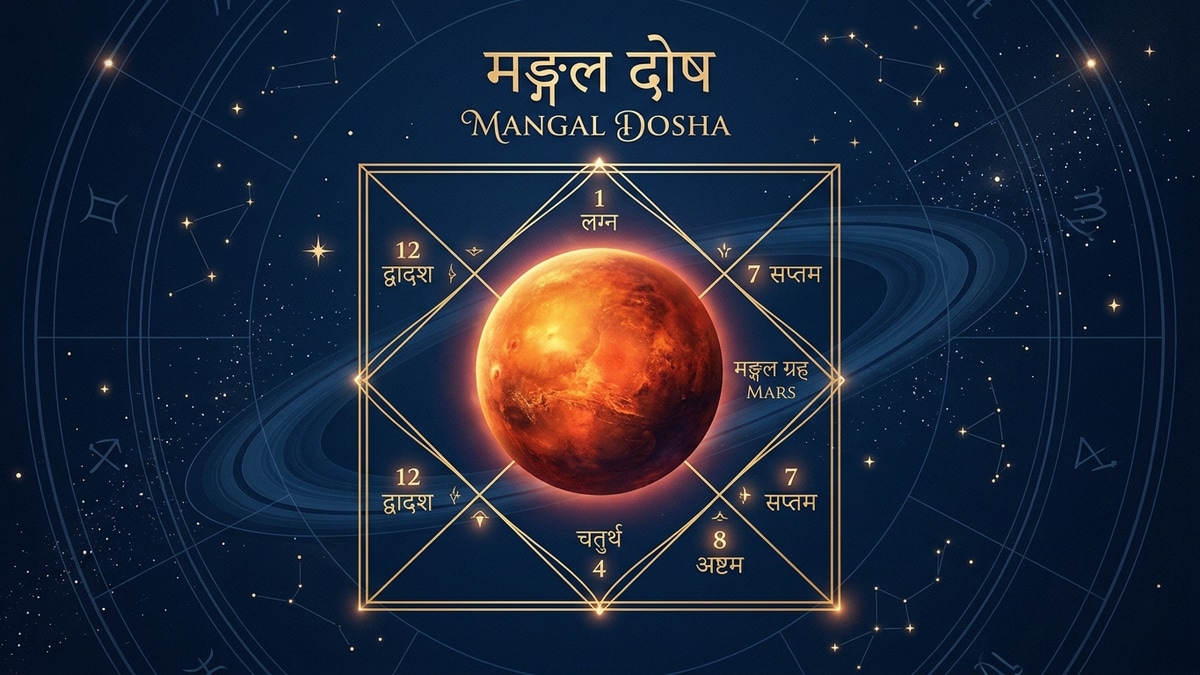
The lagna, or ascendant, is the sign rising on the eastern horizon at your birth. It is the first house of the kundali, so every house is counted from it, and Mangal dosha is read from it. It changes roughly every two hours, which is why an exact birth time matters for a kundali even more than for a rashi.
Is my birth data saved or sent anywhere?
No. The calculation runs in your browser. The only thing your phone asks our server for is the latitude, longitude and time zone of the place you pick from the list. Your name, date and time of birth are never sent, and nothing is stored when you close the page.
Can I find my rashi from my name instead?
A name gives a different thing: the naam rashi, read from the first syllable through the traditional syllable chart. Families often chose that syllable from the birth nakshatra, so the two can agree, but the janma rashi from the birth time is the one a kundali uses.